DISTRICT ENERGY AND HEATING STARTER PACK
120 DAYS · 9,500€
Cross-building energy monitoring and optimization.
problem
DISTRICT HEATING INEFFICIENCIES ARE OFTEN GUESSED, NOT MEASURED.
Common symptoms
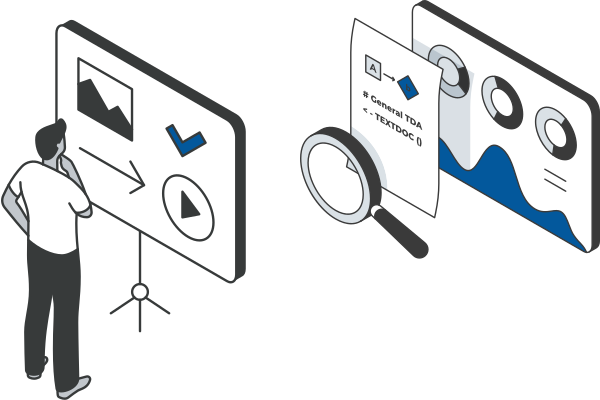
HEAT LOSSES ARE ASSUMED WITHOUT VERIFICATION
No spatial visibility.
BILLING AND METERS DIFFER
Data cannot be reconciled easily.
SUBSTATION PERFORMANCE VARIES
Causes unclear.
DEMAND PLANNING RELIES ON OUTDATED SPREADSHEETS
Forecasting lacks evidence.
CITIES DON’T NEED DIGITAL TWINS FIRST. THEY NEED HEAT NETWORK INSIGHT. YES, REALLY.
solution
HOW WE APPROACH THIS
(simple and a bit refreshing)
We map the heat network, integrate consumption and delta-T data, and identify inefficient nodes.
We connect it using:
- FIWARE / NGSI-LD Smart Data Models.
- The DCaaS data layer (already part of FiWAREBox).
- Your existing systems and IT infrastructure.
No platform migration.
No “strategic masterplan alignment committees”.
Then we expand - only if it’s worth it.

What You Get (in 120 Days)
- Network topology model.
- Efficiency dashboards.
- Hotspot and anomaly detection.
- Targeted upgrade recommendations.
This is not a pilot.
This is your operational starting point.

Who This Is OPTIMAL For
Cities that have:
- Municipal district heating companies.
- Energy and sustainability offices.
- Public infrastructure management teams.
- Regional heat providers scaling gradually.
If that sounds like your city → we’re aligned already.
We start with the Starter Pack (1,000 meters) because this gives you 80% of value in 120 days with minimal cost and no risk.
STARTER PACK
9.500€
one time setup
(40 working hours included for consulting and developing)
- Fully managed shared hosted FIWAREBox instance
- The essentials
Metadata and data viewer / editor
with
filtering, sorting, grouping, importing, exporting
Searchable metadata and data portal
Authentication and authorization
MSP connector
Database
NGSI-LD Context Broker
Basic districts/zones/buildings
Semantic model for districts/zones/buildings
5–8 dashboards
Alerts
Odoo-ready billing mapping (other ERP optional)
Data ownership
API for database access and direct Context broker access for IT team
Installation
- Support
E-mail support (Business hours)
(OPTIONAL) 12 MONTH SUPPORT EXTENSION
1.990€ per month
12-month support extension,
hosting & support, billed monthly after 120 days period
(12 working hours per month included for consulting and developing)
Support
E-mail support (Business hours)
Want the architecture walkthrough?
We’ll show:
- How the data actually flows.
- How to start with one dataset.
- How to avoid “Smart City over-construction syndrome”.
FIWAREBOX · ONE SHARED DATA LANGUAGE FOR SMART CITIES · EU OPEN STANDARDS (NGSI-LD) · YOUR INFRASTRUCTURE, YOUR RULES