Welcome to SMART CITY KISS, my slightly self-ironic attempt to tell the truth about smart cities.
We’ve spent years wandering like digital hobbits through vendor forests, “semantic mountains”, pilot projects that never scaled, and dashboards that preferred to show errors instead of data.
We learned a lot, forgot some of it, stayed stubborn on a few things… and now we’re sharing everything without the usual smart-city bullshit.
KISS means Keep It S… (Smart? Super? Stupid? You choose...) Simple.
Translation for city leaders: If a smart-city project needs a wizard, five consultants, and half of your municipal staff, it’s not smart.
This series is about what actually works: Small. Simple. Practical. Meaningful.
And the first topic? Utility data. Water. Electricity. Gas. Heat. It doesn't matter which one, similar situation, similar problems, similar solutions, but I will mostly write about water and you can map it to the other metering solutions.
The things citizens complain about, and the things that cost you millions.
WHAT FIWAREBOX IS
(AND WHAT IT IS NOT)
Let’s start with the big clarification:
FIWAREBox is not an off-the-shelf smart city platform.
We don’t parachute into your city, announce that we know everything better, install a magical cloud thing, and promise AI-powered unicorns (Yes, I could add “AI” and "LLM" to every sentence too - but let’s keep the buzzword budget for later).
What FIWAREBox actually is: A simple, powerful enabler.
We don’t replace your existing systems. We don’t take over your operations. We don’t tell you how to run your meters.
Instead, FIWAREBox gives your team the tools to:
- connect messy, scattered utility data,
- standardize it with NGSI-LD + Smart Data Models,
- add semantic meaning,
- keep everything in an open, future-proof format,
- make all data reusable for billing, planning, reporting, analytics, AI…
You keep control.
FIWAREBox simply makes your data usable — by people and machines — and prevents vendor lock-in.
WHY IT TEAMS ACTUALLY LIKE FIWAREBOX
IT departments have a dream: clean, unified, vendor-independent data.
Right now, they’re drowning in:
- 12 different APIs,
- 8 CSV exports,
- hand-edited Excel sheets,
- vendor portals with passwords nobody remembers.
FIWAREBox fixes this by offering:
- one standard interface (NGSI-LD),
- one clear data model instead of “val_01_final_final_really_final 18.25.235 .csv”,
- semantic relationships (building -> meter -> customer -> tariff -> zone),
- open APIs for dashboards, BI tools, GIS, Python, AI/ML,
- protection from vendor chaos.
FIWAREBox is not a big monolithic system. It’s the interoperability shield that keeps your IT team sane.
WHY WE CREATED STARTER PACKS
(AND WHY DECISION MAKERS LOVE THEM)
City leaders don’t want 300-page strategies.
They want three answers:
- What can we see in 60 days?
- What value does it bring?
- How much will it cost?
The Starter Pack exists exactly for that.
It follows the 20/80 rule:
With only 20% of effort, you get 80% of the value.
No megaprojects. No endless meetings. No “let’s plan for 2 years and deliver in 5.” Just real data, real dashboards, real value - fast. Once your team sees it, they immediately know where to go next.
THE CITY UTILITY DATA STARTER PACK - HOW IT WORKS
Let’s keep it simple. The Starter Pack shows how water, gas, heat, electricity and other meters can work together in a modern, open, interoperable way — without replacing your existing billing system or your meter provider.
ROLES IN THE ECOSYSTEM — CLEAR & CLEAN
Meters
They mind their business; metering, sending data. They hide in basements, manholes, and locked rooms.
- Nobody knows where half of them even are.
- Nobody wants to replace their batteries. Their battery life matters because no city wants to hire a “Chief Battery Replacement Officer.”
Evolution of metering:
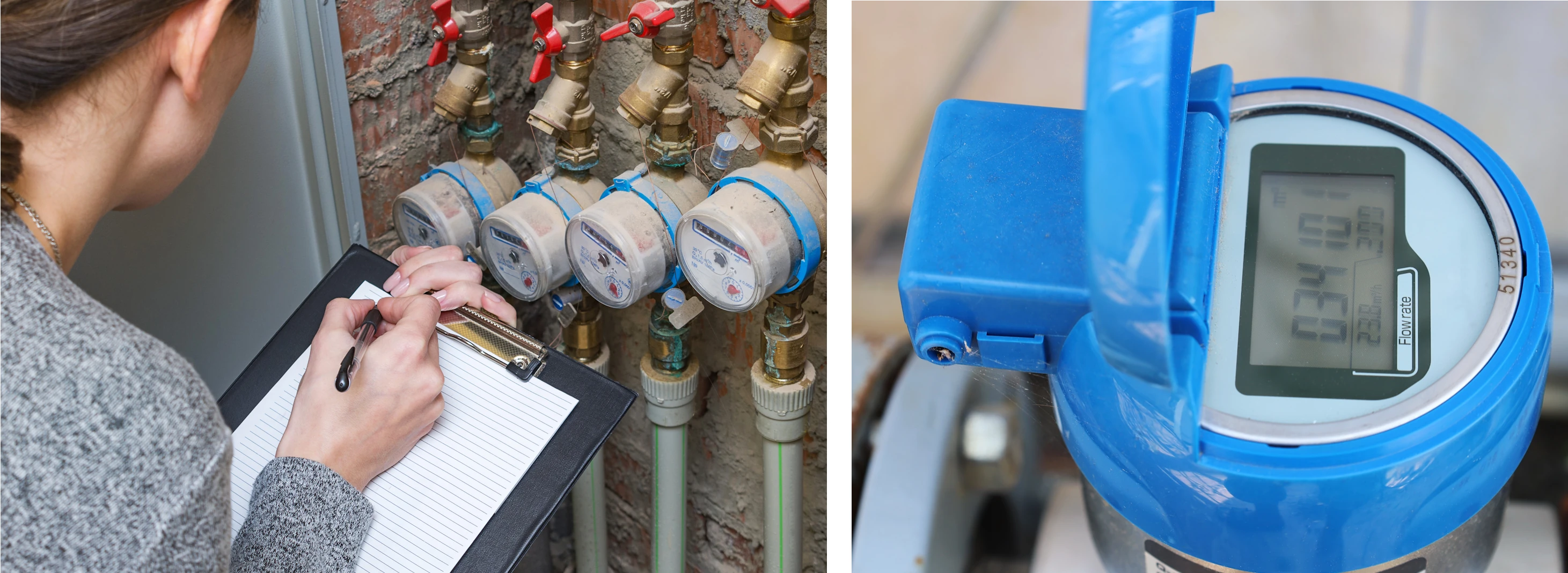
- Before: a human with a clipboard once per year.
- After: a human with a handheld terminal once per month.
- Then: M-Bus, AMR, AMI (helpful… but locked in vendor silos).
- Now: LoRaWAN / NB-IoT devices doing automatic reading for 10+ years once per day or based on the schedule.
No matter the brand, protocol or network — every meter ultimately produces: ID + timestamp + value + (optional) metadata.
FIWAREBox makes these readings consistent, searchable, comparable, interoperable.
MSP - Metering Service Provider (local partner)
They handle the physical world:
- install meters,
- maintain them,
- run LoRaWAN/NB-IoT/proprietary networks,
- collect raw readings,
- operate their own cloud/databases,
- ensure batteries, coverage, and service.
This requires local presence. This is NOT what FIWAREBox does, and shouldn’t be.
FIWAREBox - the middle layer (your data brain)
We connect to the MSP (or multiple MSPs) via API, SFTP or exports.
Then we:
- ingest all meter data,
- convert it to JSON-LD,
- apply NGSI-LD semantic models,
- clean, validate, standardize,
- store it in your NGSI-LD Context Broker,
- show dashboards,
- generate alerts,
- prepare data for billing,
- connect to GIS, ERP, Odoo, open data, AI, mobility, energy, water, waste…
FIWAREBox transforms raw readings into reusable, contextualized, city-owned data.
City IT Team
- uses clean NGSI-LD data,
- builds new automations and dashboards,
- no more wrestling with Excel and vendor APIs.
Billing Operator
They keep doing billing — because billing must follow local rules & workflows.
FIWAREBox just makes it easy:
- every reading is already mapped to customer, meter, tariff,
- no manual imports,
- no corrections,
- no vendor-specific formats.
WHAT THE MSP ACTUALLY DOES (AND WHY THEY STILL MATTER)
Raw meter data is… unpredictable. Different vendors, formats, intervals, payloads, encryption, weird quirks.
This is why cities hire MSPs.
MSP responsibilities
Field and hardware:
- install meters,
- maintain devices & batteries,
- manage LoRaWAN/NB-IoT/gateway infrastructure.
Data transport and storage:
- operate the meter network,
- collect raw readings,
- push them to their cloud/service,
- handle retries, decoding, radio issues.
FIWAREBox can replace data ingestion, but cannot replace field work & local maintenance.
Cities need MSPs — and MSPs love when someone else handles semantics, APIs, and data chaos.
WHY FIWAREBOX IS THE MIDDLE LAYER EVERY CITY NEEDS
Cities often say:
“Isn’t one more platform too much?”
Here’s the truth:
You add one more layer today To avoid 10× more problems tomorrow.
FIWAREBox prevents:
- vendor lock-in,
- proprietary data formats,
- broken API integrations,
- parallel dashboards for each utility,
- Excel-based “shadow IT”,
- chaos when switching MSPs.
And it enables:
- unified NGSI-LD data space,
- reuse of data across utilities,
- interoperability,
- billing automation,
- GIS integration,
- open data,
- advanced analytics & AI.
This middle layer is what makes your future possible.
WHAT YOU CAN ACHIEVE IN JUST 60 DAYS
With the Starter Pack, your city gets:
- real-time meter data integrated,
- MSP -> FIWAREBox pipeline running,
- semantic model for utilities,
- dashboards for water/gas/electricity/heat,
- anomaly alerts,
- unified NGSI-LD API,
- a clean data catalog,
- billing-ready data for Odoo/SAP,
- first building blocks for a full city data space.
Small cost. Small risk. Big insight.
A REAL EXAMPLE
(for everyone who read this far)
A small European city — 4,000 LoRaWAN water meters.
They already had:
- multiple LoRaWAN gateways, multiple old-fashion meters ( Data collected manually with a handheld terminal),
- a local MSP operating the network,
- MSP cloud with meter data,
- a billing operator using the MSP’s API,
- some dashboards.
On paper, they had “everything.” In reality, not so, a vendor locked solution.
What we did with FIWAREBox:
We gave them two options:
Option 1: Replace MSP entirely
Meters send data directly to FIWAREBox.
But this requires:
- rebuilding LoRaWAN infrastructure,
- replacing gateways,
- changing broker URLs on every meter -> too expensive for a small city.
Option 2: Keep MSP, connect to it (they chose this)
We:
- connected to the MSP API,
- created a connector,
- pulled all meter data automatically,
- converted everything to JSON-LD,
- applied Smart Data Models: linked meters -> buildings -> customers -> zones,
- created clean dashboards & anomaly alerts,
- added a semantic layer,
- prepared Odoo billing mapping (just as an example what can be done with a non specialised but capable general purpose ERP),
- prepared tools for IT department to be as independent as possible and do with their data what so ever they think they need to do.
What the city gained:
1️. Full ownership of its data (no lock-in).
2️. Ability to combine meter data with:
- weather,
- GIS,
- district heating,
- SCADA data,
- building plans,
- anything else the need.
3. The internal IT department can create its own reports without asking vendors. Or export and integrate data.
4️. Billing became simpler (even with different meter brands, multi-flat buildings, mixed tariffs, shared meters, corrections, etc.).
5. They can benchmark against other cities.
6️. They can later add more packs (Energy, Mobility, Buildings, DCaaS, DSaaS…) without replacing the foundation / platform.
FIWAREBox became the brain and the connector, not the meter vendor, not the billing vendor - and definitely not another big, expensive, locked box.
STARTER PACK VS FULL BLOWN PLATFORM (THE REALITY CHECK)
| Topic | FIWAREBox Starter Pack (1k meters) | FIWAREBox Full Platform (10k - 100k meters) | Other provider Full Platform (10k - 100k meters |
| Investment | € | €€€ | €€€€ |
| Delivery time | 60 days | 3 - 6 months | 6 - 12 months |
| Scope | Essential utility data flow | Full smart utility platform | Full smart utility platform |
| Billing | Basic Odoo or other ERP or already made custom billing - ready mapping | Full automation & workflows | Full automation & workflows |
| Semantic model | Core | Full multi-utility (FIWAREBox) | Usually none |
| MSP integration | Advanced, multi-MSP, high-volume | Advanced, multi-MSP, high-volume | It depends, high-volume |
| Data ownership | Yes | Yes | No |
| Risk | Very low | Moderate | High |
| Perfect for | Small towns & first steps | Mid/large cities | Mid/large cities |
Upgradable | To Full Platform | From Starter Pack | None |
Vendor locked | No | No | It depends, but usually yes |
WHY “ONE EXTRA LAYER” IS ACTUALLY LESS COMPLEX
Yes, it sounds ironic, but it’s true.
Adding FIWAREBox at the start prevents:
- MSP lock-in,
- API chaos,
- 20 different dashboards,
- redoing everything later,
- expensive custom integrations,
- throwing away data when switching vendors.
With FIWAREBox, you can even:
- stop using the MSP for data transport (if you ever choose to),
- stop using the billing operator or migrate to another one (if you ever choose to) - link to any ERP for billing,
- build your own Data Space (DCaaS, DSaaS),
- simply add new modules (Mobility, Energy, Waste…) without rebuilding anything.
You start simple — but you build on a foundation that never becomes obsolete.
WHAT SHOULD WE CONNECT OR WRITE ABOUT NEXT?
We are preparing the next use case. It could be EV charging infrastructure, parking data fusion, water and energy cross-border flows, logistics corridors, or even a full regional mobility dashboard.
Tell us which direction you want us to explore next.
DISAGREE, COMMENT, OR WISH TO KNOW MORE?